The London Borough of Barnet holds a singular place in British aviation history. What began as a patch of fields in Colindale became the crucible of aerial innovation, hosting the first official airmail service in the United Kingdom, pioneering night flights, and eventually transforming into one of the world's finest aviation museums.
The Balloon and the Birth of Hendon Aerodrome
Long before fixed-wing aircraft dominated the skies above Barnet, Hendon was attracting aeronauts. In 1862, Henry Coxwell and James Glaisher ascended from the site in the "Mammoth" balloon, conducting meteorological experiments that pushed the boundaries of scientific understanding. This early flight established Hendon as a location of aerial significance, though the true transformation would not arrive for nearly half a century.
Hendon Aerodrome began operations around 1908, situated seven miles northwest of Charing Cross. The first powered flight from the site came in 1909, when Henry Spencer piloted an 88-foot non-rigid airship built by the Spencer Brothers. His passenger was Muriel Matters, the Australian suffragette who would later achieve fame for her political activism. This flight marked Hendon's entry into the powered aviation era.
The following year brought international attention. On 27 April 1910, the French aviator Louis Paulhan made the first true heavier-than-air flight from Hendon, flying 117 miles to Lichfield; the longest flight achieved in the United Kingdom at that time. This demonstration of aviation's potential caught the attention of a young British pioneer who would reshape Hendon's destiny.
Claude Grahame-White: The Man Who Gave Hendon Wings
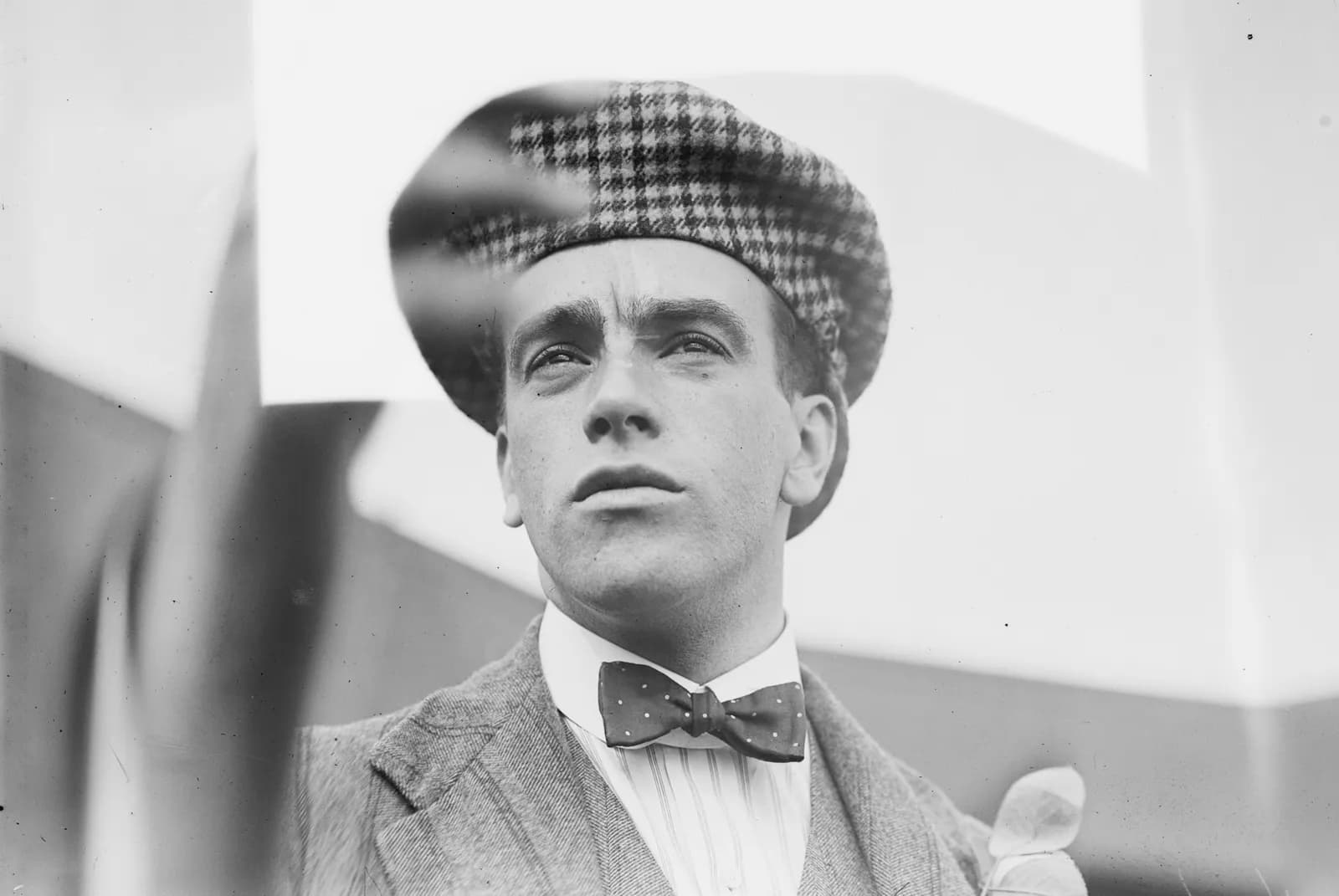
Claude Grahame-White was born on 21 August 1879 in Bursledon, Hampshire. Inspired by Louis Blériot's Channel crossing in 1909, he became one of the first qualified pilots in England, receiving Royal Aero Club certificate number 6 in April 1910. His competitive spirit and technical innovation would prove instrumental in establishing Hendon as a centre of aviation excellence.
In April 1910, Grahame-White competed against Louis Paulhan in the Daily Mail London to Manchester air race. Though Paulhan won, Grahame-White achieved a historic first; he made the first night-time take-off in aviation history during the competition. This pioneering spirit would define his contributions to Hendon and British aviation.
In 1911, Grahame-White formed the Grahame-White Aviation Company and took control of more than 200 acres of Colindale, converting the land into a proper modern airfield. He established a flying school at Hendon that would train numerous pilots, including Cheridah de Beauvoir Stocks, who became the second British woman to gain a Royal Aero Club aviator's licence in November 1911. His commitment to advancing aviation extended to founding the Women's Aerial League in 1909, recognising the role women would play in the future of flight.
The First Airmail and Aviation Spectacles
Perhaps Hendon's most celebrated aviation first came in September 1911. From 9 to 16 September, the first official United Kingdom airmail service operated between Hendon and Windsor, timed to coincide with the coronation celebrations of King George V. This pioneering experiment established Hendon as a hub of aviation innovation and demonstrated the practical potential of aerial transport.
The aerodrome also became famous for public spectacles that drew enormous crowds. The first Aerial Derby took place on 8 June 1912, starting and finishing at Hendon Aerodrome. Approximately 45,000 people paid to view the start and finish, whilst an estimated three million spectators gathered across London; two million of whom had never seen an aircraft in flight before. By 1925, the annual RAF Display at Hendon was attracting 100,000 spectators, making it a fixture of London's social calendar.
War and Transformation
The outbreak of the First World War transformed Hendon from a civilian airfield into a military installation. Grahame-White himself contributed to the war effort, flying the first night patrol mission on 5 September 1914. He and members of the Royal Naval Air Service mounted the first aerial defence of London in 1915, pioneering techniques of night-time interception that would prove crucial in future conflicts.
The War Office commandeered the flying schools in November 1916, and the aerodrome trained 490 pilots during the conflict. Women continued to make their mark; Cicely Ethel Wilkinson qualified as a pilot at the Beatty School at Hendon on 11 September 1916, receiving Royal Aero Club Aviator Certificate number 3522. She was possibly the only woman to qualify as a pilot in Britain during the First World War.
Following the war, Hendon remained under military control. From 1927 to 1939, it housed No. 601 Squadron, nicknamed the "Millionaires' Squadron" for the wealthy backgrounds of its members. The first RAF Pageant was held at Hendon in 1920, becoming the regular Royal Air Force Display from 1925, and Empire Air Day from 1938. During the Second World War, RAF Hendon was briefly active during the Battle of Britain, though it was mainly used for transport activities.
The Last Flight and a New Beginning
The post-war era brought change. The last flying unit, the Metropolitan Communication Squadron, left Hendon in November 1957. The last aircraft to land at the aerodrome was a Blackburn Beverley, flown in late 1968 specifically to become a museum exhibit. The runways were removed by 1969, and the RAF station officially closed on 1 April 1987.
Yet this was not the end of Hendon's aviation story. On 15 November 1972, Queen Elizabeth II officially opened the Royal Air Force Museum London at the Colindale site. The museum initially housed 36 aircraft in its hangars; by 2012, the collection had grown to over 100 aircraft. The Battle of Britain Hall was opened by Queen Elizabeth The Queen Mother in November 1978.
Today, the museum stands as a testament to Hendon's aviation heritage. Notable exhibits include the Avro Lancaster S-Sugar, which flew 137 night sorties during the Second World War, and the only complete Hawker Typhoon in existence. The Grahame-White Factory, an original First World War aircraft factory hangar, houses the museum's First World War collection. In 2018, to mark the RAF Centenary, the museum added the Westland Sea King flown by Prince William, a Gnat jet trainer used by the Red Arrows, and an F-35 Lightning II mock-up.
The Local Legacy
Hendon's aviation heritage lives on in the fabric of Barnet itself. The Grahame Park housing estate, built in the 1970s, was named in honour of Claude Grahame-White. The estate, a joint project between the Greater London Council and Barnet Council, saw its first family move in on 23 October 1971. Buildings throughout the estate bear names that recall the area's aviation history.
The Royal Air Force Museum London continues to welcome visitors, with 431,037 attendees recorded in 2025. Located at Grahame Park Way, Colindale, it serves as both a world-class museum and a reminder of how this corner of Barnet shaped the history of human flight.
From the balloon ascents of the 1860s to the airmail pioneering of 1911, from the wartime training of pilots to the preservation of aviation heritage today, Hendon's skies have witnessed remarkable chapters in the story of flight. The transformation from active aerodrome to museum marks not an ending, but the continuation of Barnet's enduring connection to aviation history.